
Wedding rings / Design and fitting guide
Wedding ring models: see how they look on your hand.
Two rings that look the same on the display may feel completely different on the finger. One is wide, the other is high; In one, the shine of the metal attracts attention, and in the other, a thin row of stones. The only choice is "yellow or white?" Don't leave it to the question.
Compare 14 designs side by side, then clarify fineness, size and care. The aim is not to find the most expensive pair, but one you will want to wear every day.
Why is a single "wedding ring type" list not enough?
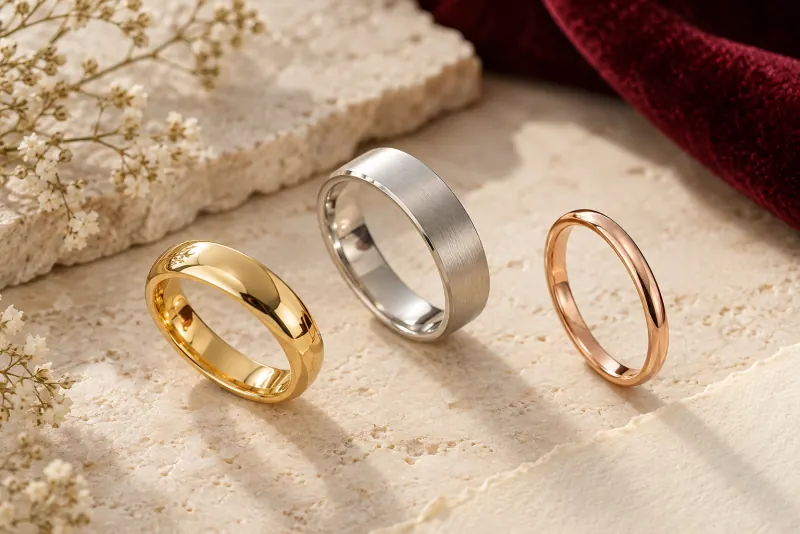
'14 carat', 'matte' and 'comfort fit' describe different things: gold content, surface finish and the profile against your finger. A matte ring can also be yellow gold, wide and comfort fit. Comparing these in separate columns makes it easier to see what you like.
Appearance
Straight or curved? Is it shiny or textured? Do you want stone or edge detail? The 14 views below tell this side.
Material
Metal, gold fineness, plating and any stone details. Rings that look the same colour may differ in material and care requirements.
How it feels on your hand
Band width, thickness and inner profile. Reading millimetres on a screen is not the same as trying the ring on your finger.
The selection here is prepared to compare design families; it is not a Türkiye sales ranking or a brand's product catalogue. Images convey the idea of the model; metal setting or stone quality cannot be verified from photography.
14 wedding ring models: from plain ring to stone designs
Shortlist two or three looks first. Then try them on at the same width and similar size. This way, you can distinguish whether you find a design comfortable because you really like it or just because it's thinner.
External profile: curved or straight?
Classic domed wedding ring
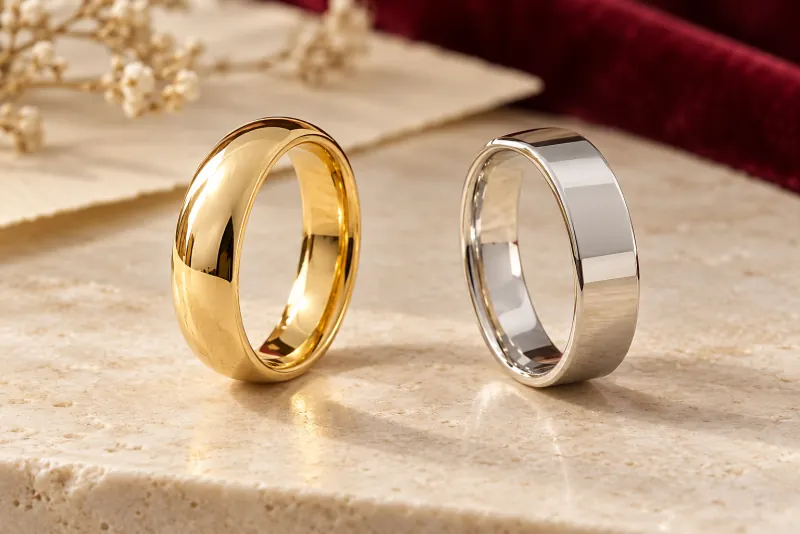
A single line of metal with a softly domed outer surface. Bright yellow gives it a traditional look, but it can also be white or rose-toned. If you enjoy the shape of a ring more than a prominent stone, it is a useful starting point.
A curved outer appearance does not mean that the inside of the ring is also curved. Try the same model separately with plain interior and comfort fit interior profile. Even if you like the shine that carries light across the surface, also evaluate the ring as you open and close your hand; don't judge just by its appearance in the window.
Check at the fitting: Ask about the height of the outer camber, how the edges feel between the fingers, and what the inner profile is.
Simple wedding ring with straight profile
This band has a flatter outer surface and more defined lines. It can echo the simplicity of a square watch or geometric jewellery. A crisp look does not require sharp edges; you can ask for softened edges too.
Two plain rings that look similar from above may feel completely different in the hand due to the thickness and internal profile. Consider the smooth outer surface and comfortable inner camber together. If you have another ring that you wear all the time, try them both side by side; look at the height difference as well as the color of the metal.
Check at the fitting: Note the edge rounding and band thickness; Distinguish between the sharp line in the photo and the edge felt on the finger.
Bandwidth: a thin line or a distinct surface?
Fine wedding band
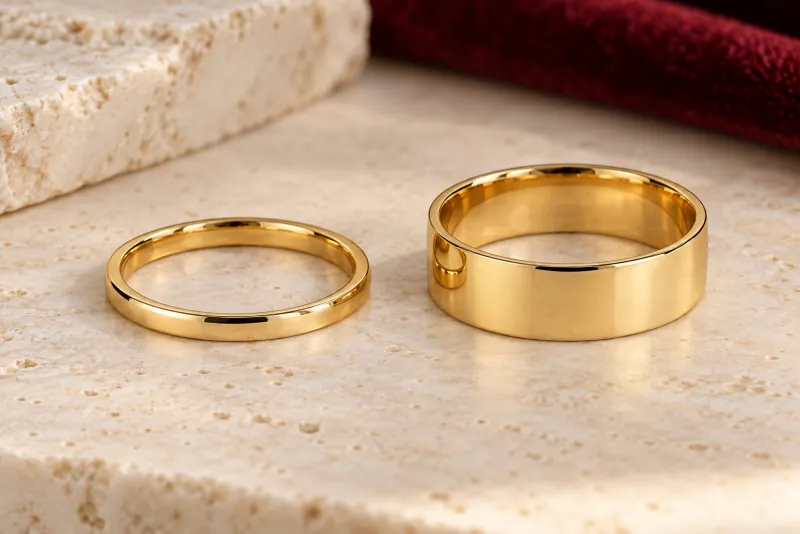
An early option to try if you want a slim line on your finger or a set with a solitaire. A ring that looks delicate alone takes up more space when another ring sits beside it. Try it on the way you plan to wear it.
Do not assume a thin ring is always comfortable or that rings of the same fineness are equally durable. Band thickness and construction matter too. Decide whether a slim profile, low weight or sitting close to a solitaire is your priority; explain those wishes separately rather than expecting one word to cover all three.
Check at the fitting: Request width, thickness and grams together. If you're considering interior text, ask if the text you've chosen fits within this band.
Wide band wedding ring
A larger metal surface creates a stronger silhouette. It can be flat, domed, matte or two-tone; width is not a pattern. One partner may prefer a wider design while the other chooses a slim band.
Do not automatically use a size measured with a narrow sizing ring for a wide band. Choose the width, then try a sizing ring close to it. Bring your fingers together, make a fist and hold a pen; even a short shop visit lets you try everyday movements.
Check at the fitting: Ask to take measurements with a wide band and try the same width with different interior profiles; do not add or subtract numbers yourself.
Surface: matte and textured options
Matte or satin-finish band
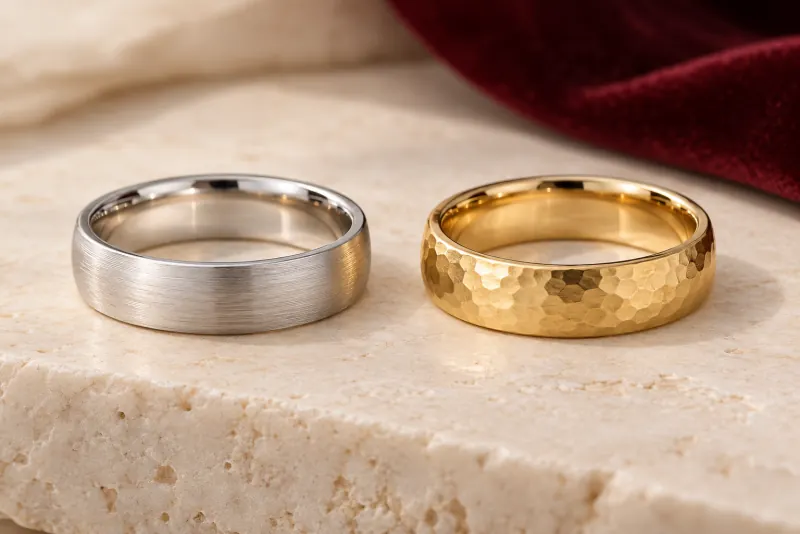
An option if you prefer a surface that diffuses light rather than a mirror shine. 'Matte' is not one process: finishes can be brushed, satin or textured in different directions. Compare the real piece as you turn it in the light.
Don't confuse this appearance with the promise of scratch resistance. Ask the seller how your chosen finish may change with use and how it regenerates in maintenance. Combining the matte middle band with the shiny edge can be another try for those who do not want the entire ring to have the same texture.
Check at the fitting: Before buying, ask about refinishing, its cost and how it would affect the existing texture.
Hammered wedding band
Small, irregular surface marks give this style its character rather than a uniform line. It is an alternative to a plain metal band for those who prefer an organic look. Try both a subtle texture like the illustration and more deeply marked examples, rather than treating them as identical.
The surface already has movement, so consider how busy it looks with your other jewellery. Texture depth, band thickness and edge finish vary. Do not infer 'handmade' from appearance alone; ask how it is made and maintained.
Check at the fitting: Check the smoothness of the inner surface and both edges; ask whether the texture is confined to the outside.
Small details: edges and lines
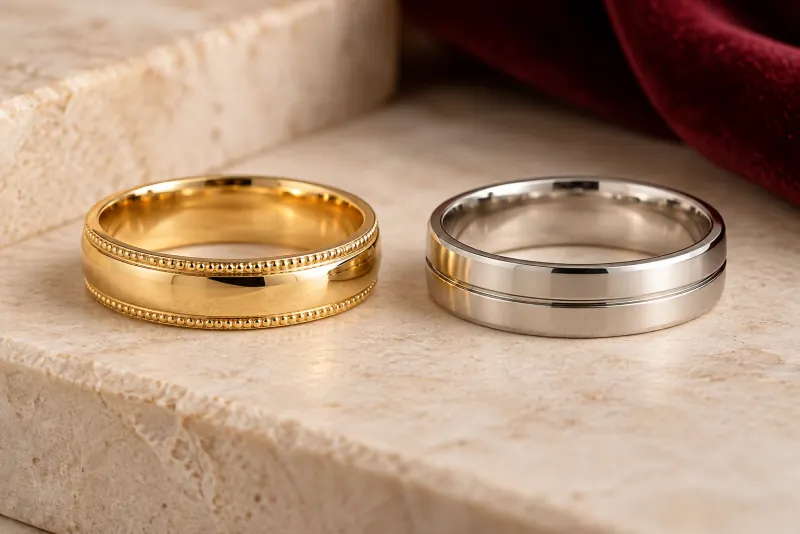
Vintage wedding ring with Milgrain edge
Tiny beads along the edge form a delicate frame around a plain band. This detail can add a vintage feel without large motifs. With a simple centre, the ring looks understated from a distance and more intricate up close.
It is not necessary for the detail to be on both sides; compare single-edged or smaller-grain options. Try to see if a thin border, visible in the photo, is noticeable between the fingers. Also ask about the effect of subsequent polishing on the detail; not every surface is renewed in the same way.
Check at the fitting: Rehearse the feeling of particles catching or rubbing; learn how to maintain the continuity of the edge pattern when size changes.
Slotted/striped wedding ring
It is separated from the plain band by one or more lines. The line can be in the middle, close to the edge, or at different angles. It offers an in-between option for those who find a flat surface too empty and a dense pattern too lively.
Decorative line is not the same as channel setting, in which stones are placed between two metal rails. Look at the depth of the line on the sample and how it divides the surface. Make your decision not only based on a single photo you see on the internet, but also based on the side view and bottom part of the ring.
Check at the fitting: Ask whether the groove runs around the whole ring and whether resizing would require work on the pattern.
Multiple stripes: two colors and weave
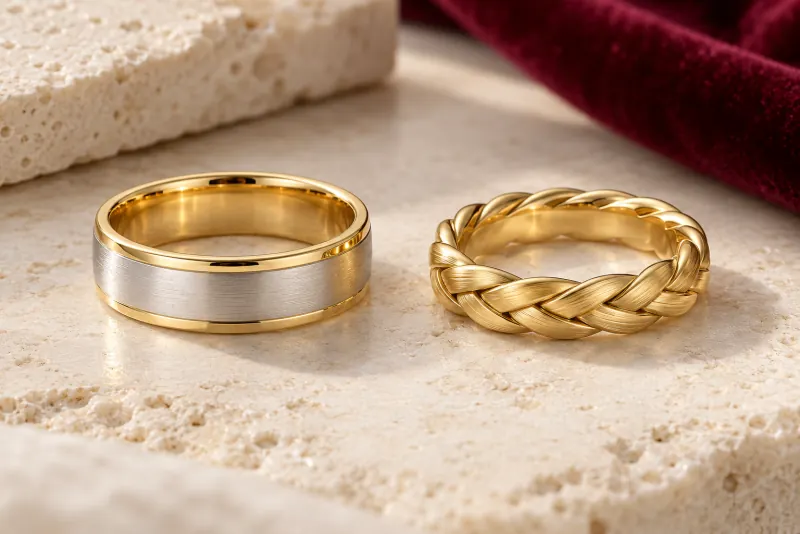
Two-tone wedding ring
This style combines yellow and white, or another pair of tones, in one band. It is worth considering if you wear different jewellery colours day to day. A shared stripe of colour can connect a pair of rings without making them identical.
The color difference may come from two different alloys, coatings or another manufacturing approach. These options are not the same in terms of maintenance. Look at the clarity of the color border, the color of the inner surface and how the pattern continues in the lower part; don't just compare the top view.
Check at the fitting: Ask in writing for which parts are in which metal/carat and what needs to be replaced, if any.
Knitted pattern wedding ring
Offers a more textured design with the feel of overlapping stripes. Do not judge band thickness only from the outer border of the pattern; also see if there is a flat supporting surface on the inside. Not every product with a knitted appearance is produced in the same structure.
Choose how distinct you want the pattern to be on the hand: a tight, low braid and a high, defined braid can look completely different next to each other. If your partner does not like the same texture, you can share one color of the braid in a plain band. You don't have to buy two copies of the same set.
Check at the fitting: Ask about the structure of the inner part, the height of the outer texture and how the pattern will be completed if the size is changed.
Stone wedding ring: also select the setting
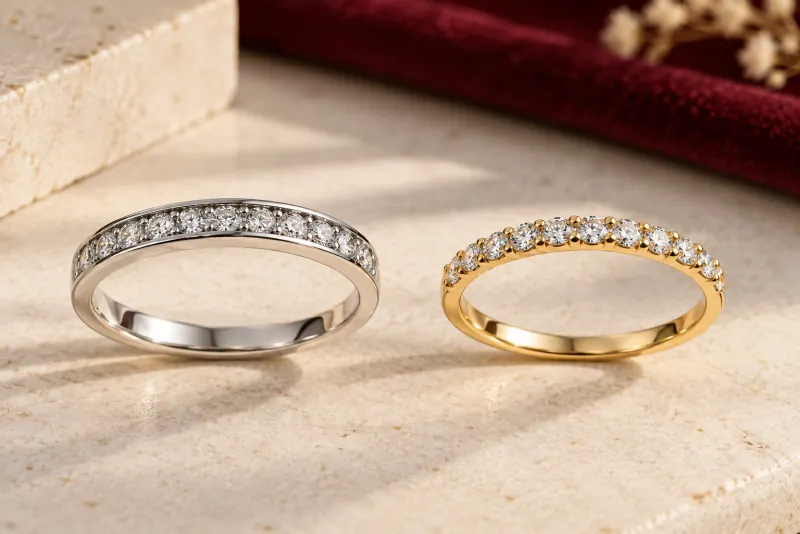
Channel-set wedding band
Small stones sit in a row between two metal edges. Instead of individual projecting prongs, you see two lines bordering the stones. This is a style to try if you want sparkle within a defined, more contained metal frame.
Channel edges may leave the stones less exposed, but that does not make a ring impact-proof or maintenance-free. The setting is separate from how far the stones extend around the band: half- and full-eternity rings can use different settings. Do not identify a stone solely from a photograph.
Check at the fitting: Ask about stone type, total stone weight, setting control, and the process when a stone needs to be renewed.
Half-eternity wedding band
The stones cover only one part of the band, the upper part in most designs; the lower section remains plain metal. It is worth comparing for those who do not want a full-circle sparkle or are looking for a combination of a stony look and a plain bottom surface.
The length of the stone-set section, stone count and setting vary by product. Rings all described as 'half-eternity' may look different on your hand. Consider whether it would bother you if the plain section became visible when the ring turned. A stone-free lower section does not guarantee that every design is easy to resize.
Check at the fitting: Learn the range that can be changed in size and whether the process will affect the stone slots specifically for this model.
Full circle sparkle or form accompanying the solitaire
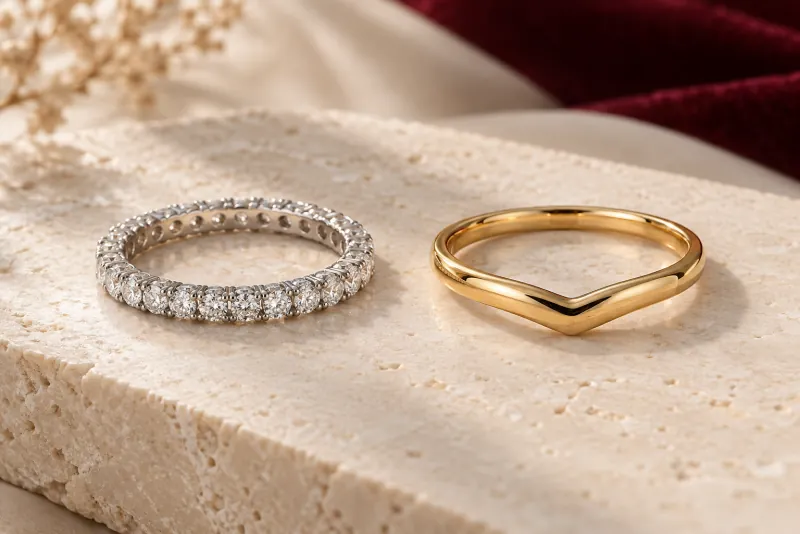
Full circle stone wedding ring
Stones continue around the entire band, so the ring stays stone-set in appearance as it turns. The difference from a half-eternity band is not simply 'more stones': the section against your palm is stone-set too, which changes how it feels during a fitting.
Take the size selection and service conditions particularly seriously here. It may be difficult to change the size of models with full circumference stones; some models may require rebuilding or replacement. Don't settle for "we'll make it smaller later". For comfort, close your hand and evaluate its contact with other fingers.
Check at the fitting: Ask whether a future size change would mean resizing, replacement or remaking the ring, and how you would find out the cost.
V-shaped / contour wedding ring
A design family with a slight V or curve at the front to leave room for an adjacent ring. Consider it if you want a set that follows the outline of a solitaire. Do not assume every solitaire of the same cut will fit it equally well.
Bring the solitaire or other ring you will wear with it to the fitting. Check the gap you want, any contact with the stone setting and their combined width on your finger. Also look at the contour alone; you may not wear the rings as a set every day.
Check at the fitting: Have the jeweler check the contact points of the two parts; just because they appear side by side in the photo is not proof of harmony.
Yellow gold, white gold, rose gold and platinum
Treat metal colour and fineness as separate choices. Yellow, white and rose gold shades depend on alloy composition. Platinum is a different metal, not another name for white gold. There is no rule dictated by your skin tone; bring a favourite watch or frequently worn jewellery to compare alongside it.
| Option | What to look for in appearance? | What should you ask the seller? |
|---|---|---|
| Yellow gold | A warm yellow tone, suitable for both plain polished bands and textured finishes. | Ask about fineness, weight and thickness, and whether the sample has the same tone as the ring you are ordering. |
| White gold | Cool white appearance; some products have rhodium plating. | Is there a coating? How would it be renewed and priced? What is the alloy composition? |
| Rose / rose gold | Pink tones where copper is effective. The tone of two products sold under the same name may not be the same. | View a real sample in daylight and confirm that both rings can be made in your chosen tone. |
| Platinum | A distinct white metal. Don't equate it with white gold just because it "looks white". | Ask about the fineness mark, alloy, weight and the maintenance and resizing services for that design. |
What do 8, 14, 18 and 22 karats mean?
Karats describe gold's share out of 24 parts: 8/24 for 8-karat, 14/24 for 14-karat, 18/24 for 18-karat and 22/24 for 22-karat gold. For example, 18-karat gold is nominally 75 per cent gold. The rest consists of the other metals in the alloy. Do not confuse gold karats with carats used to measure gemstone weight.
That number alone does not mean a ring is better for everyone. Profile, thickness, craftsmanship and intended use matter too. Compare 14- and 18-carat examples of the same design; if one is thin and light and the other wide and heavy, you cannot isolate the effect of fineness.
If you are considering silver or other metal
First find out the clear name of the material and the coating, if any. Do not consider color similarity to be equivalent to gold or platinum. In particular, ask in writing whether resizing, coating renewal and repair services are offered for that product. If you have known metal sensitivities, do not rely on color or the “skin-friendly” label alone; ask for alloy information.
Width, thickness and comfort fit: decide at the fitting
Width is the band area of the ring on the finger. Thickness is the height of the metal extending from the inner surface to the outer surface. A wide but low ring does not give the same feeling as a narrow but high ring. Request millimeter information separately; the expression “thick wedding ring” alone is not enough.
Comfort fitdescribes a rounded inner surface. A traditionally domed exterior does not mean the inside has the same shape; a flat-looking ring can have a rounded interior. Look at it from the side and try a sample close to the width you will buy.
- Put it on and take it off. Evaluate with the jeweler the fit and feel of the ring through the joint. Just once it gets on the finger does not prove the correct size.
- Move your hand naturally. Open and close your fingers. If you are deciding between two rings, note their width and profile rather than simply holding your hand still for a photograph.
- Try final width. Do not automatically carry a size measured for a narrow band over to a wide one. The order should clearly state the sizing system and inner profile.
- Resolve size doubts before ordering. Do not measure at home with string or paper and treat it as an exact number. Have the finger and joint difference checked by professional measurement.
Do not apply a blanket online rule such as 'go half a size down for comfort fit' to every product. There is no universal adjustment across sizing systems and profiles. If unsure about size, try it again before personalising, especially for stone-set, patterned and full-eternity designs.
The two partners' wedding bands do not have to be identical
One of you may prefer a fine, stone-set ring while the other likes a wider matte band. Rather than asking one person to give up their choice, share a detail: the same metal tone, a similar groove, matching milgrain edges or simply the same date engraved inside. Matching does not require the same width on both hands.
Try two-tone designs if your everyday jewellery mixes colours. But do not assume that two tones automatically work with every combination. Look at the ring beside your watch, engagement ring or bracelet. Each partner's size still needs to be assessed separately when buying a pair.
If you are going to wear a wedding ring and solitaire together
Take the other ring to the fitting. Does the flat ring touch the stone seat? Does the contoured model really reduce the gap? Do two pieces overlap or rub against each other? Not only the top photo but also the side profile is important. Love your wedding ring even when you wear it alone; you may not want to use both rings together every day.
When comparing wedding ring prices, compare the same product
No single current price list explains every wedding ring. Besides the metal and fineness, weight, band thickness, craftsmanship, stones and personalisation affect the quote. Do not compare two package prices without the product details.
- Single ring or double? Let the scope of the offer, two separate sizes and the features of each ring be clear.
- Metal and weight: Fineness, weight or weight range, width and thickness should be listed together. Ask how the weight and cost change with ring size.
- Stone: Is the stone a natural diamond, a laboratory-grown diamond, zirconia or something else? The word 'stone-set' does not identify the material. Ask for the number of stones and their total weight where applicable.
- Workmanship and finish: What does the first offer include? How is the renewal of the matte surface, rhodium or repair charged later?
- Measurement and delivery: Confirm the final size check, production time and timing of any adjustments. Do not rely on a schedule with no margin before the ceremony.
Confirm the inner text in the last step
Check the names, Turkish characters, date and line order one by one in the order form. Confirm that the letter character and text will fit inside the ring. It's easy to remember the wrong date; it is useful for two people to read independently of each other. Please read the exchange conditions after measurement or customization before payment.
If you are going to shop online instead of in store, also ask for side and interior profile photos of the actual product. The same collection name may not mean the same width or the same stone type. Check that the number and product code in the cart match the model you talked about in the call.
Scratches, changing finishes and care
Fine marks may appear on a polished surface; matte and textured finishes can change with wear too. Do not rely on a claim that one design 'never scratches'. Ask how refinishing would be applied to the pattern and what might change. Avoid indiscriminate polishing, especially on defined grooves, milgrain and braided details.
Avoid contact with cleaning products and bleach; store the ring safely, separate from other jewellery, when not wearing it. Follow care guidance for its metal, plating and stones rather than polishing with abrasives or trying an online mixture at home. If a stone moves, a prong bends or something catches, have it checked.
When discussing maintenance service, do not just use the phrase "lifelong maintenance". Cleaning, resurfacing, coating, stone control and size change are separate processes; find out which ones are included and which ones are paid.
Final checklist before buying
- Have both of you tried a sample close to your ring's final width and profile?
- Does the order clearly state the metal, fineness, any plating and the stone type?
- Do the gram/gram range, width and thickness information match the offer?
- Have the size changes and repair limits of the stone model been announced for that product?
- If you are going to wear it with your other ring, have you checked the side profile?
- Were the inner text, Turkish characters and date read by two people?
- Is there time for delivery, a final fitting and any adjustments?
- Have you seen the personalization, measurement and exchange conditions before payment?
If one of these questions is unanswered, you do not need to choose the model again. Keep the ring you like on your short list and fill in the missing information. A good choice often comes not from seeing another design, but from learning the details of the design you like.
Wedding-band questions answered
Are a wedding ring and a solitaire the same thing?
No. Wedding ring mostly refers to a band-shaped wedding ring, while solitaire refers to a design that highlights a single main stone. It can also be a stone wedding ring. If you are going to wear them together, look at their profiles and contact points, not just their names.
Should I buy a 14 carat or 18 carat wedding ring?
14 and 18 carat describe different gold contents; neither tells you on its own which is right for you. Try examples with the same width, thickness and craftsmanship. Consider your budget, preferred tone and maintenance expectations together; no single fineness is best for everyone.
Is an 8-karat wedding band gold?
8-carat gold contains 8 parts gold in 24, approximately 33.3 percent. This is not the same as plating. Check the fineness, metal details and invoice description; a gold colour alone proves neither content nor quality.
Are white gold and platinum the same?
No. White gold is a gold alloy; Platinum is a different metal. White gold items may have rhodium plating. Find out the alloy, coating information and maintenance conditions of the product from the seller; the color white does not indicate that the products are equivalent.
What does Comfort fit mean?
Comfort fit describes a rounded inner surface where the ring touches your finger. It is different from a domed outer surface. It will not feel the same on every hand. Try the final width and profile rather than adding or subtracting a fixed amount from your size yourself.
Is a thin or thick wedding ring more comfortable?
Band width, metal thickness, internal profile and finger structure are effective together. Instead of deciding from a single photo, try two samples, thin and wide; Close and open your fingers. Do not automatically transfer the result from a narrow measuring ring to a wide band.
Does the size of a full circle wedding ring change?
Changing the size of models with full circumference stones may be difficult and may not be possible in every product. Ask the seller about the range that can be applied to that model, the effect of the process on the stones and, if not possible, the replacement/reconstruction condition before purchasing.
Do both wedding bands have to be the same design?
No. A common metal tone, a similar edge or the same inner text can establish harmony. One of you may choose a stony and thin band, the other may choose a matte and wider band. Consider rings that are comfortable for two people separately.
Why can a wedding band scratch or change its matte finish?
Jewellery surfaces can change with everyday wear and contact. No photograph guarantees scratch resistance. The metal, finish and way the ring is worn all matter. Follow the specific product's instructions for cleaning and refinishing.
What information should I ask for when buying a wedding ring online?
Ask for fineness and metal, width, thickness, weight or weight range, stone type, finish, sizing system and service terms. Confirm any engraving before it is done, and read exchange conditions after personalisation or resizing in advance.